Lesson 3: Pete Dye and the Brutalist Revolution
If Alister MacKenzie represented golf architecture’s classical tradition — elegant, strategic, democratic, beautiful — then Pete Dye represented its most significant rebellion against that tradition.
Dye was born in Urbana, Ohio in 1925. He came to architecture relatively late, designing his first course in the late 1950s after a career as an insurance salesman and amateur golfer. He had no formal training in landscape design or engineering. What he had was an unconventional eye, a willingness to break rules, and a deep conviction that golf courses had become too comfortable.
What he built changed the game permanently.
Dye’s Philosophy: Make the Player Uncomfortable
Where MacKenzie believed that difficulty should emerge from strategic complexity — the player choosing incorrectly and paying the price — Dye believed that courses should impose difficulty physically and psychologically. He designed courses that were hard to look at as well as hard to play: severe angles, forced carries over water, railroad tie bulkheads framing bunkers and hazards, island greens surrounded entirely by water.
Dye’s courses were not merely strategic puzzles. They were confrontations. They demanded physical precision and psychological nerve. They punished mistakes with a severity that MacKenzie would have considered excessive and that many players found genuinely intimidating.
This approach has been described — both admiringly and critically — as brutalism: an architectural sensibility that prioritizes raw challenge and visual impact over elegance and playability.
The Stadium Course at PGA West
Perhaps the most extreme expression of Dye’s philosophy is the Stadium Course at PGA West in La Quinta, California, completed in 1986. It was designed specifically to challenge the best players in the world — and it succeeded so thoroughly that it became known informally as “the Beast.”
The course features the most famous — or infamous — short par-3 in American golf: the 17th hole, known as Alcatraz. The green is an island of grass surrounded entirely by water, accessible only by a small footbridge. There is no margin for error. The shot must carry the water and land on the green. Miss it — in any direction, by any amount — and the ball is in the water.
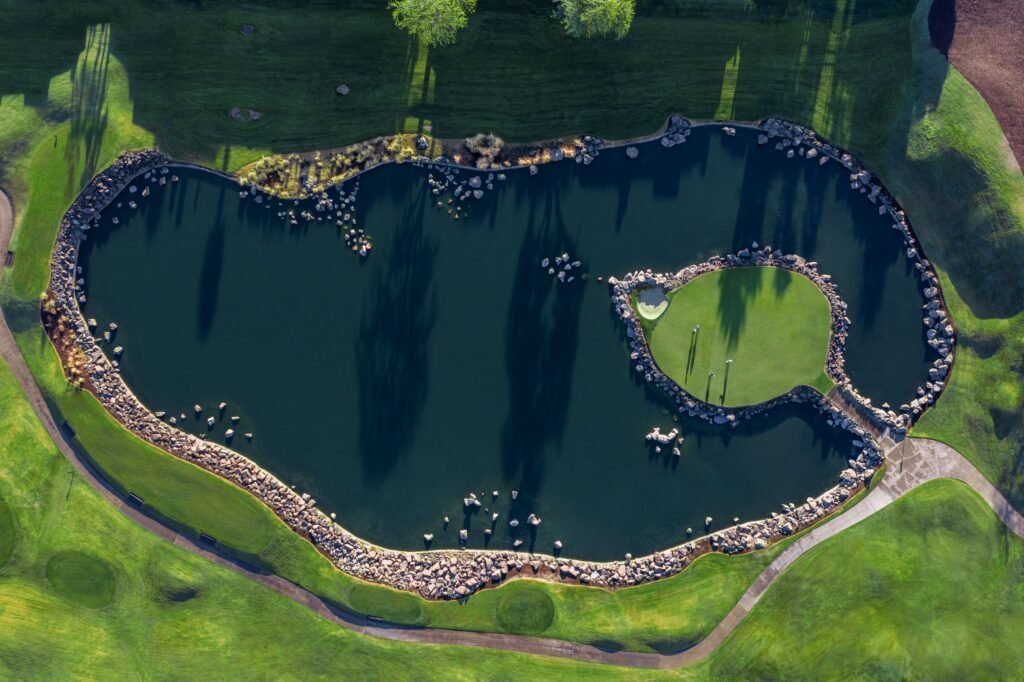
There is nothing strategic about Alcatraz. There is no alternative route, no safe play, no conservative option. You either hit the green or you don’t. This is Dye at his most pure: golf as pure confrontation between player and hole.
The TPC Sawgrass Stadium Course
Dye’s most visible work is the Stadium Course at TPC Sawgrass in Ponte Vedra Beach, Florida — the permanent home of The Players Championship and, for several decades, the course that more professional golfers have played on television than any other.
TPC Sawgrass opened in 1982. Its 17th hole — another island green par-3, smaller and more exposed than Alcatraz — became arguably the most famous single hole in American golf. It has produced more drama, more heartbreak, and more memorable moments in televised golf than almost any other hole in the world.
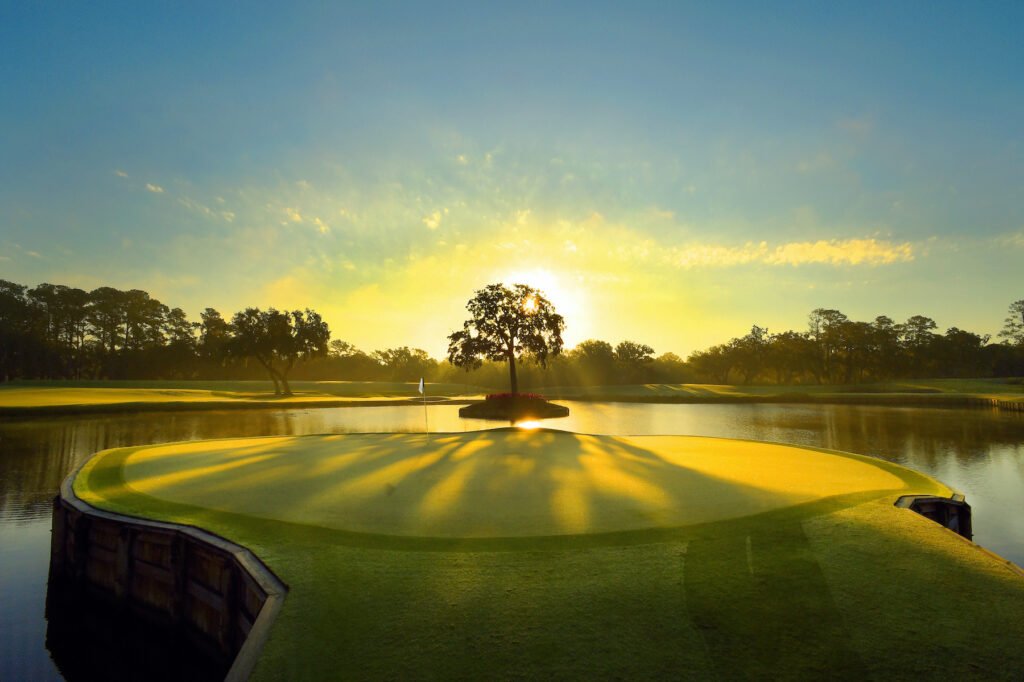
The course was controversial when it opened. Many tour professionals complained that it was unfair — that the severity of the penalties, the difficulty of the terrain, and the psychological pressure it imposed went beyond what a fair examination of golf skill should require.
Dye’s response was essentially: good.
He believed that the best players in the world should be genuinely tested — that a course that professionals found comfortable was a course that had failed at its purpose. His courses were designed to reveal the limits of players, not to flatter their abilities.
The Debate Dye Opened
Dye’s work forced a debate that continues in golf architecture today: what is a golf course actually for?
Is it, as MacKenzie believed, primarily a strategic canvas that rewards intelligent play and remains enjoyable for golfers of all abilities? Or is it, as Dye suggested, primarily a test — a severe, uncompromising examination of skill, nerve, and precision that should challenge even the best players in the world?
This debate is not merely aesthetic. It has practical consequences for how courses are designed, who can enjoy them, how the game is experienced at every level. A course designed on Dye’s principles may be thrilling for elite players and miserable for average ones. A course designed on MacKenzie’s principles may be endlessly enjoyable for average players and insufficiently challenging for the elite.
The tension between these philosophies has shaped every significant course design of the past 40 years.
Dye’s Influence
Dye’s impact on subsequent architects has been profound. Tom Doak, Bill Coore, Ben Crenshaw, and others who came after him — even those who disagreed with his most extreme tendencies — were forced to define their own philosophies in relation to his. He made it impossible to design a golf course without thinking seriously about what challenge was for.
He also, perhaps inadvertently, created the conditions for a revival of classical architecture. In reaction to Dye’s brutalism, a generation of architects returned to MacKenzie’s principles — strategic design, multiple routes, democratic difficulty — as a corrective to what they saw as the excesses of the 1980s course-building boom.
Pete Dye died in January 2020 at age 94. The course named after him at PGA Golf Club — one of the three courses at your facility — is a direct part of his legacy.