Lesson 3: Lee Elder and The Masters
The Augusta National Golf Club opened in 1933. It hosted the first Masters Tournament in 1934. For 41 years after that, no Black golfer competed in it.
This was not because no Black golfer was good enough. It was because Augusta National — a private club with the power to set its own invitation criteria — had never extended an invitation to one.
The Masters and its Invitation System
Unlike most PGA Tour events, the Masters operates on an invitation system controlled entirely by Augusta National. The club decides who plays. This gave Augusta extraordinary power to maintain exclusion long after the PGA’s Caucasian-only clause was removed.
Through the 1960s and into the early 1970s, as Charlie Sifford and other Black players competed and won on tour, the Masters continued to find reasons not to invite them. The qualification criteria conveniently excluded the tournaments and categories where Black players were most competitive.
Lee Elder
Lee Elder turned professional in 1959. Like Sifford, he had grown up caddying, learned the game from the outside, and fought his way onto the PGA Tour after the Caucasian-only clause was removed.
He was talented, consistent, and competitive. But he was not invited to the Masters.
The qualification pathway that would have most naturally led to an invitation — winning a PGA Tour event — was complicated by the fact that Elder had come close multiple times without breaking through at the right moment.
Then, in 1974, Lee Elder won the Monsanto Open. Under the Masters’ own stated criteria, a PGA Tour victory earned an invitation. Augusta National could no longer exclude him without openly contradicting its own rules.
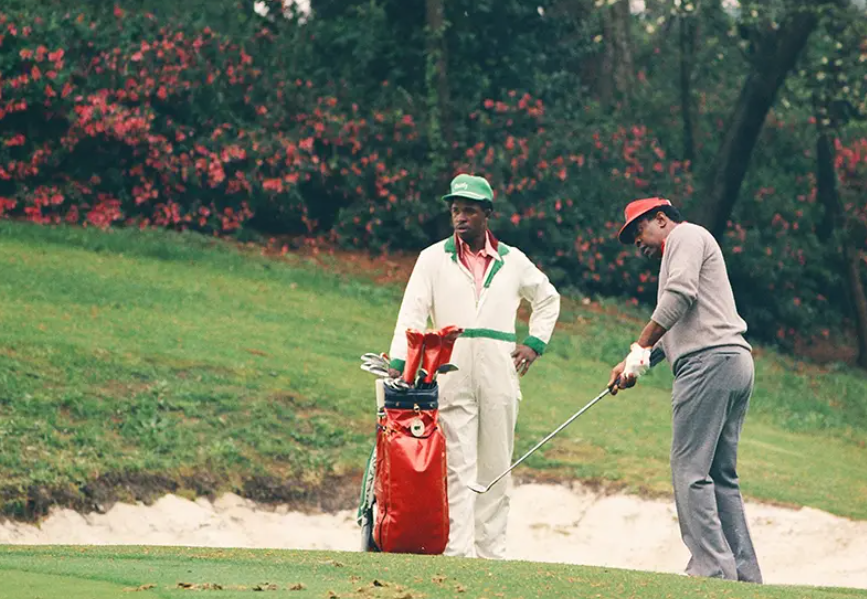
In April 1975, Lee Elder became the first Black golfer to compete in the Masters Tournament. He was 40 years old.
What happened when he arrived
Elder received death threats before the tournament. He and his wife rented two houses in Augusta during tournament week — so they could move between them if one was targeted. He brought his own security. He played under conditions no other competitor faced.
He did not make the cut that year. But he was there. And the door, once opened, could not be closed again.
Elder went on to play in the Masters six times. He was awarded an honorary starter role at the 2021 Masters, alongside Jack Nicklaus and Gary Player — the first Black golfer to hold that distinction.
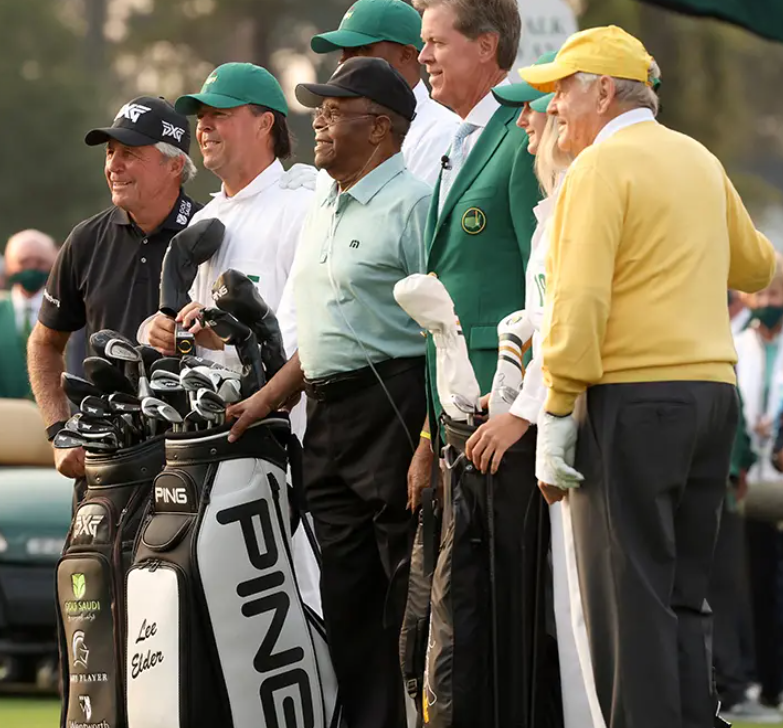
He died in November 2021, at age 87.