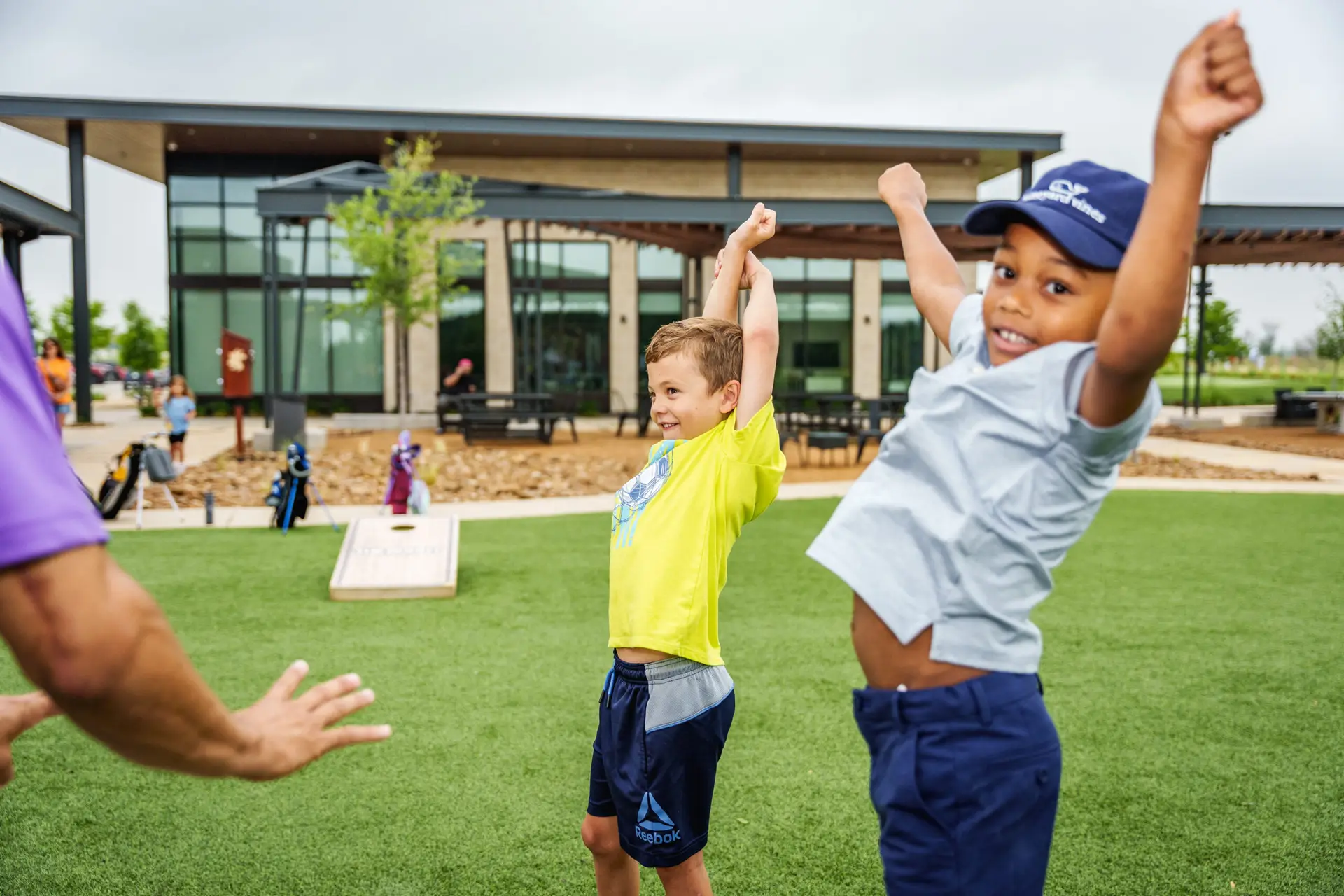
There is a window in your child’s development – roughly between ages 6 and 10 – when the nervous system is uniquely receptive to learning new movement patterns. Coaches call it the “skill window,” and it is one of the most well-documented phenomena in sport science.
The good news: you do not need a private lesson every week to take advantage of it. You need consistent repetition of seven foundational skills, delivered in short, joyful practice sessions by the most motivated teacher your child will ever have – you.
Hear are the seven fundamentals the American Development Model identifies as essential before age 10, and how to build each one at home.
1. A Correct Grip
The grip is the only connection between your child and the club. Everything else – swing path, face angle, power – flows from it. A grip learned incorrectly before age 10 becomes deeply ingrained and costly to correct later.
The correct grip for a young player is a ten-finger (baseball) or an interlocking grip. Bothe are fine. What matters: the club sits in the fingers, not the palm. The “V” formed by each thumb and forefinger points roughly toward the right shoulder (for right-handers).
Practice this: have your child pick up a club the way the would pick up a hammer – instinctively, without thinking. Then make one small adjustment: move the club from the palm into the fingers. Ten grips per day, every day. Within a month it is automatic.
2. Athletic Posture
Stand with your feet shoulder-width apar. Bend your knees slightly. Hinge forward form the hips – not the waist – until your arms hang naturally in from of your body. Now ask: could you jump from this position?
If yes, that is athletic posture. It is the same position a shortstop uses before a pitch, a tennis player before a serve, and a basketball player before a free throw. Golf is an athletic movement – it begins from an athletic position.
Help your child find this position in a mirror. Check for two common errors: a rounded back (from hinging from the waist instead of the hips) and locked knees. Five minutes of mirror work per week builds the habit.
3. A Balanced Setup
Athletic posture is the foundation. A balanced setup adds three things: correct foot width, appropriate ball position, and balanced weight distribution.
- Foot width: shoulder-width for most shots
- Ball position: roughly centered for short irons, slightly forward for longer clubs
- Weight distribution: 50/50 at address, with a slight bias toward the balls of the feet – not the heels
A simple test: if you can tap your toes while in setup, your weight is too far backk. if you feel presssure on the balls of your feet and could reach quickly to move in any direction, the balance is right.
4. The Pendulum Putting Stroke
Putting accounts for approximately 43% of all shots in a round of golf. Teaching your child to putt well before age 10 is one of the highest-leverage investments you can make in their game.
The putting stroke at this age has one principle: the pendulum. Arms and putter move together, controlled by the rocking of the shoulders. Wrists stay quiet and firm. Backswing and follow-through are approximately equal in length.
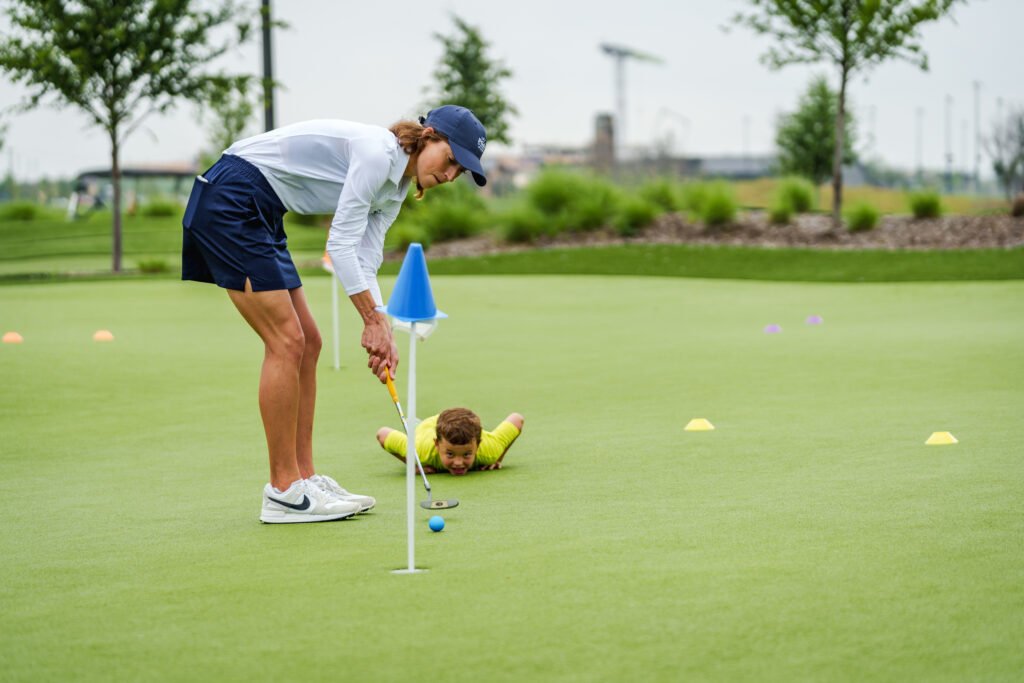
Practice this with a metronome if possible. One click back, one click through. The rhythm matters more than the technique at this stage.
5. A Chip Shot That Gets the Ball Airborne
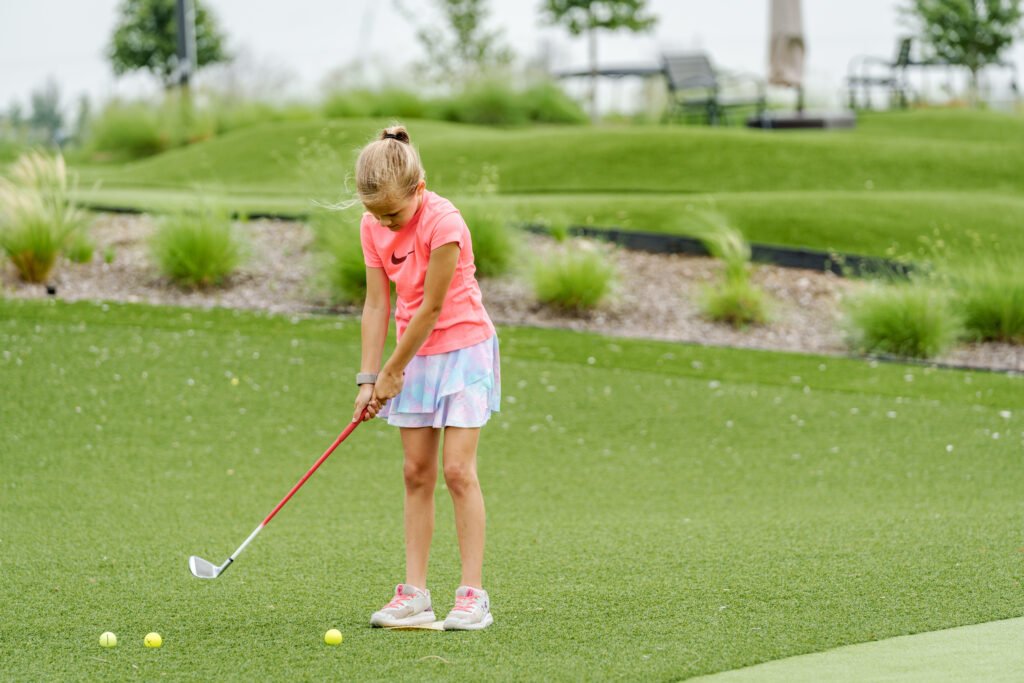
The chip shot – a short, low shot that carries a few yards and then rolls toward the hole – is the first full-motion shot children should learn. It requires only a half-swing and reinforces the most important lesson in all of golf: the club creates lift. You do not scoop.
6. Basic Rules Awareness
Setup for chipping: narrow stance, weight slightly forward, ball back in the stance, hands slightly ahead of the ball. The swing is a pendulum, – the club brushes the ground through impact and the loft of the face sends the ball up. Ten minutes of chipping in the backyard, three times per week, is all that is required.
Children who understand why the rules of golf exist – not just what they say – devlop a relationship with the game that goes beyond score. The rules are not obstacles. They are the game.
Three rules every child should know before age 10
- We are quiet when others are hitting
- We rake the bunker after we play from it
- We count every stroke honestly – including misses
These are not rules. They are character habits that the game teaches naturally when presented with care and patience.
7. Honest Scorekeeping
Keeping your own socre accurately – including missed shots, penalties, and everything that actually happened – is a life skill, not jsut a golf skill. It requries honesty with yourself and integrity toward your playing partners.
Start simple: tally marks on a paer scorecard, one mark per storke. Add them up togehter at the end of each hole. Celebrate accurate counting, not low numbers. The habit of honest scorekeeping, built early, pays dividends across every aspect of your child’s character for the rest of their life.
Building These Fundamentals With the Right Curriculum
Everyone one of these seven fundamentals is addressed directly in the Homeschool Golf Academy Stage 1 and Stage 2 curriculum – with complete lesson plans, parent coaching guides, and activities designed to build each skill through joyful, age-appropriate repetition.
You do not need to figure out the sequence yoruself. You need to show up, be present, and follwo the plan.
Your child’s skill window is open right now. Let us help you make the most of it.